

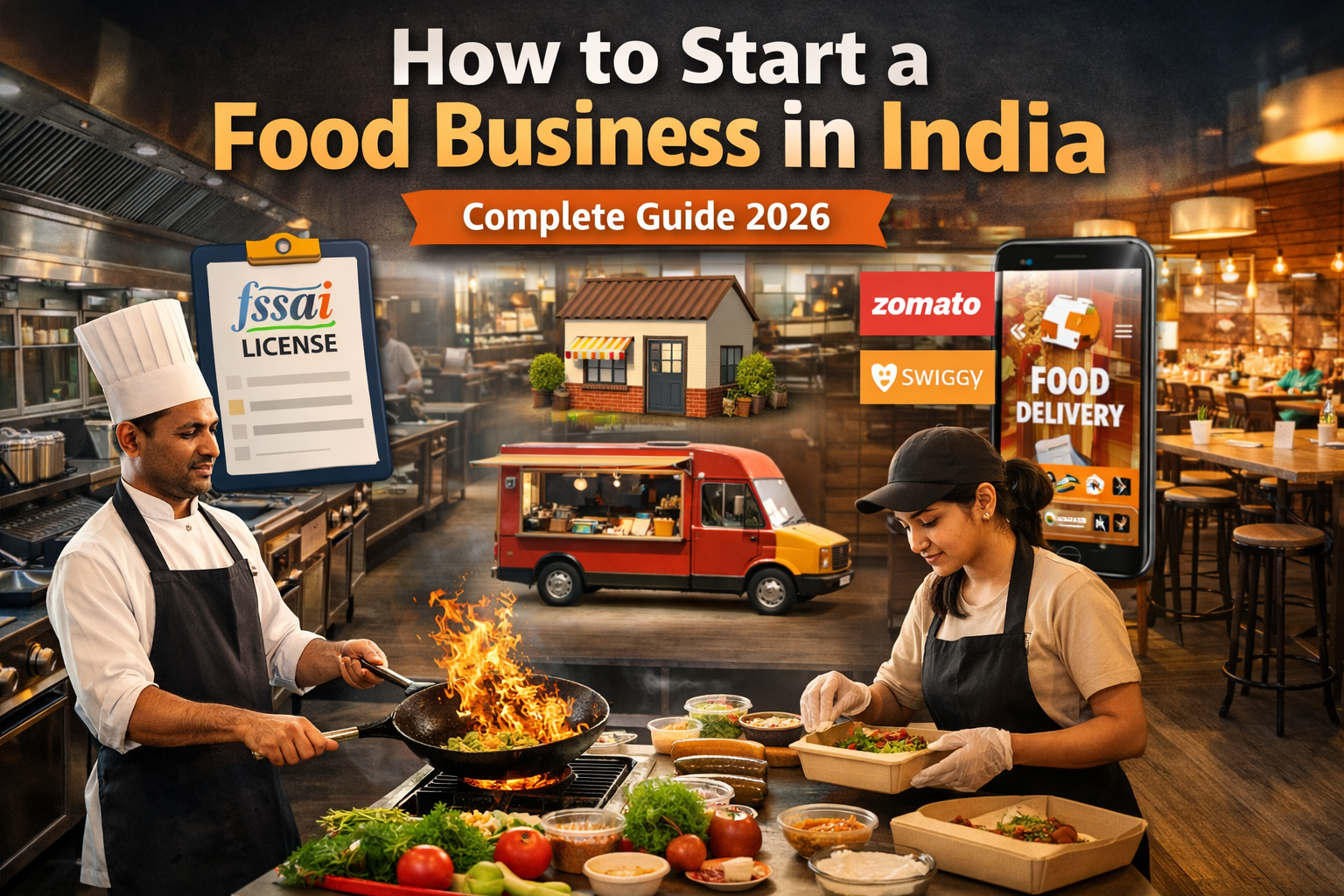
Start a Food Business explained: this guide covers what Start a Food Business means, who it applies to, the step-by-step process, documents required, fees, due dates and penalties in India — so you can stay compliant with confidence and avoid costly mistakes.
India's food industry is one of the fastest-growing sectors in the economy, and for good reason. Rapid urbanization, changing lifestyles, the explosive growth of food delivery platforms like Zomato and Swiggy, and an ever-increasing appetite for new cuisines have created a massive opportunity for entrepreneurs at every scale. Whether you are a home cook looking to monetize your recipes, a young entrepreneur interested in cloud kitchens, or an investor planning a full-fledged restaurant, the Indian food market offers room for everyone—provided you plan properly, comply with the law, and execute with discipline.
This guide walks you through every stage of starting a food business in India, from choosing the right model and obtaining licenses to building a brand and managing finances.
Choosing the Right Food Business Model
Before investing a single rupee, you need to decide which model suits your budget, skill set, and long-term vision. Each model comes with its own set of advantages and challenges.
Home-Based Food Business (Tiffin Service, Home Kitchen)
This is the simplest entry point. If you are a skilled cook with limited capital, a home-based food business allows you to start with minimal overhead. Tiffin services, homemade snacks, pickles, sweets for festivals, and specialty meals for specific dietary needs (such as diabetic-friendly or Jain food) are popular categories. The investment is low—typically limited to ingredients, packaging, and a basic delivery arrangement.

Cloud Kitchen (Delivery-Only Kitchen)
Cloud kitchens have become one of the most popular food business models in India. These kitchens operate without any dine-in facility and serve customers exclusively through online delivery platforms. The biggest advantage is cost efficiency—you do not need a prime retail location, customer-facing interiors, or front-of-house staff.
A single cloud kitchen space can even operate multiple virtual brands, each targeting a different cuisine or customer segment. For example, one kitchen might run a biryani brand, a burger brand, and a dessert brand simultaneously, all from the same physical location.
Cloud kitchens typically require FSSAI State License (for annual turnover between ₹1.5 crore and ₹50 crore) along with a trade license from the local municipal authority.
Restaurant or Café
Restaurants and cafés offer the advantage of direct customer interaction, brand building, and the ability to create a unique dining experience. However, the investment is significantly higher. You need to account for rent (which can be substantial in urban areas), interiors, furniture, kitchen equipment, staffing, and ongoing operational costs.
This model requires multiple licenses and permits, including FSSAI License, GST Registration, trade license, fire safety certificate (NOC from Fire Department), health/trade NOC from the local municipal corporation, liquor license (if applicable), signage permission, and environmental clearance (for establishments above a certain size).
Packaged Food Products (Snacks, Spices, Ready-to-Eat Meals)
If your goal is to build a consumer product brand rather than a service-based food business, manufacturing and selling packaged food is the route to explore. This includes items like namkeen, chips, spices, sauces, frozen foods, or ready-to-eat meals.
This model requires the highest level of compliance. In addition to FSSAI Central License (mandatory if turnover exceeds ₹50 crore or if you sell across state borders), you must comply with the Food Safety and Standards (Packaging and Labelling) Regulations, 2011, which mandate specific details on every product label including ingredients, nutritional information, manufacturing date, expiry date, allergen declarations, FSSAI license number, and the name and address of the manufacturer.
Legal and Regulatory Compliance – What Licenses Do You Need?
Compliance is not optional. Operating a food business without proper licenses exposes you to penalties, closure orders, and reputational damage. Below is a detailed breakdown of the key registrations and licenses.
FSSAI Registration or License
The Food Safety and Standards Act, 2006, read with the Food Safety and Standards (Licensing and Registration of Food Businesses) Regulations, 2011, categorizes food business operators into three tiers:
| Category | Applicable To | Type |
|---|---|---|
| Basic Registration | Petty food businesses with annual turnover up to ₹1.5 crore | Registration |
| State License | Businesses with turnover between ₹1.5 crore and ₹50 crore | License |
| Central License | Large manufacturers, importers, businesses operating in multiple states, or turnover exceeding ₹50 crore | License |
The FSSAI license number must be displayed prominently at the business premises and on all packaging materials. Failure to obtain an FSSAI license can attract a penalty of up to ₹5 lakh under Section 63 of the FSS Act, 2006.
Business Entity Registration
You must register your business under an appropriate legal structure. The most common options for food businesses are:
- Sole Proprietorship – Simplest to set up, ideal for very small operations. No separate legal identity from the owner.
- Partnership Firm – Suitable when two or more individuals want to pool resources. Governed by the Indian Partnership Act, 1932.
- Limited Liability Partnership (LLP) – Offers limited liability protection to partners while keeping compliance requirements moderate. Governed by the Limited Liability Partnership Act, 2008.
- Private Limited Company – Best suited for businesses planning to raise external funding, scale aggressively, or establish a corporate brand. Governed by the Companies Act, 2013.
GST Registration
Under the Central Goods and Services Tax Act, 2017, GST registration is mandatory if your aggregate turnover exceeds ₹40 lakh (₹20 lakh for special category states). However, even if your turnover is below the threshold, registration is mandatory if you supply goods through e-commerce platforms (such as Zomato or Swiggy), as per Section 24(ix) of the CGST Act, 2017.
Food items attract different GST rates depending on their classification. For instance, most restaurant services attract 5% GST without input tax credit, while packaged food items may attract 5%, 12%, or 18% depending on the specific product and its HSN classification.
Other Permits and NOCs
Depending on the nature and scale of your food business, you may also need:
- Trade License from the local municipal authority
- Health/Trade NOC
- Fire Safety NOC (especially for restaurants)
- Shops and Establishment Act Registration under the applicable State Shops and Establishments Act
- Pollution Control Board NOC (for manufacturing units)
- Liquor License (if serving alcohol, governed by the relevant State Excise Act)
- Eating House License (required in certain states like Delhi under the Delhi Police Act)
- Signage or Hoarding Permission from the local municipal body
Setting Up Your Kitchen and Infrastructure
Whether you are operating from home, a cloud kitchen, or a full restaurant, the physical setup of your kitchen must comply with the hygiene and safety standards prescribed under the Food Safety and Standards (Food Business Licensing and Registration) Regulations, 2011, specifically Schedule 4, which lays down the General Hygienic and Sanitary Practices to be followed by all food business operators.
Key requirements include:
- Adequate ventilation and lighting in cooking and storage areas
- Clean water supply compliant with Bureau of Indian Standards (BIS) specifications for drinking water (IS 10500)
- Proper waste disposal systems
- Pest control measures
- Separate storage areas for raw and cooked food to prevent cross-contamination
- Personal hygiene practices for all food handlers, including regular health checkups
- Temperature-controlled storage for perishable items
Equipment selection should be based on the type of cuisine and volume of food you plan to prepare. Commercial-grade cooking appliances, refrigeration units, food processors, and exhaust systems are standard requirements for cloud kitchens and restaurants. For home-based operations, domestic kitchen equipment may suffice initially, but as volumes increase, upgrading becomes necessary.
Packaging is especially critical for delivery-based businesses. The packaging must maintain food temperature, prevent spillage, and be food-safe. Under the Food Safety and Standards (Packaging) Regulations, 2018, food contact materials must comply with Indian Standards and must not transfer any harmful substance to the food.
Menu Planning and Pricing Strategy
A common mistake first-time food entrepreneurs make is offering too many items from the start. A focused, well-tested menu is far more effective than a large, unfocused one.
Start by identifying your core offering—the dishes or products that differentiate you from competitors. Analyse the food cost percentage for each item. A general industry benchmark is to keep food costs between 28% and 35% of the selling price. This means if an item costs ₹70 to prepare, the selling price should ideally be between ₹200 and ₹250 to maintain healthy margins after accounting for packaging, delivery commissions, and operational expenses.
Illustrative Example:
| Item | Raw Material Cost | Packaging Cost | Total Cost | Selling Price | Food Cost % |
|---|---|---|---|---|---|
| Paneer Biryani | ₹65 | ₹12 | ₹77 | ₹249 | 30.9% |
| Chicken Thali | ₹80 | ₹15 | ₹95 | ₹299 | 31.8% |
| Masala Chai (500ml) | ₹18 | ₹8 | ₹26 | ₹79 | 32.9% |
Note: The above figures are illustrative only and may vary based on location, vendor pricing, and scale of operations.
Pricing should also factor in platform commissions. Zomato and Swiggy typically charge between 18% and 28% commission on each order. This significantly impacts margins and should be accounted for when setting your menu prices.
Branding, Packaging, and Online Presence
In a crowded market, branding is what separates a forgettable food business from a memorable one. Your brand identity includes your business name, logo, colour scheme, packaging design, tone of communication, and overall customer experience.
For packaged food products, labelling must strictly comply with the Food Safety and Standards (Labelling and Display) Regulations, 2020. Every pre-packaged food product must display:
- Name of the food product
- List of ingredients in descending order of composition
- Nutritional information per 100g or per serving
- Name and complete address of the manufacturer or packer
- FSSAI license number and logo
- Net quantity
- Date of manufacture and best before/use by date
- Lot or batch number
- Allergen declaration
- Veg/Non-Veg symbol as per the regulation
Establishing a strong online presence is essential in today's market. Listing on Zomato and Swiggy provides immediate visibility. A well-maintained Instagram page with high-quality food photography can attract a loyal following. Creating a Google Business Profile improves local search visibility and allows customers to find your location, operating hours, and reviews easily.
Marketing Strategies for Growth
Marketing for a food business operates on multiple levels:
Organic Marketing includes consistent social media posting, engaging with followers, encouraging customer reviews on platforms like Google and Zomato, and word-of-mouth referrals. User-generated content, where customers share photos and reviews of your food, is among the most effective forms of organic marketing.
Paid Marketing includes targeted advertisements on Instagram, Facebook, and Google. Collaborations with local food influencers and bloggers can provide a significant boost in visibility, particularly during the launch phase. Sponsored listings on Zomato and Swiggy can improve your ranking and order volume.
Local and Community Marketing remains highly effective for small and medium-sized businesses. WhatsApp broadcast lists, local event sponsorships, pamphlet distribution in nearby residential societies, and tie-ups with corporate offices for bulk orders are practical strategies that deliver results.
Offering introductory deals, combo meals, and loyalty programs can help attract first-time customers and encourage repeat orders.
Financial Management and Profitability
A food business can be profitable from early stages if costs are managed effectively. The key expense categories to monitor include:
- Raw material costs – Negotiate with multiple vendors and buy in bulk where possible to reduce ingredient costs.
- Labour costs – Keep staffing lean initially and expand as demand grows.
- Rent and utilities – For restaurants and cloud kitchens, rent is often the largest fixed cost. Negotiate favourable lease terms.
- Platform commissions – Factor these into your pricing strategy rather than absorbing them from your margins.
- Packaging costs – Invest in functional, branded packaging that enhances the customer experience without being excessively expensive.
- Marketing expenses – Allocate a fixed percentage of revenue (typically 5% to 10%) towards marketing.
Maintain accurate financial records from Day 1. Use accounting software or engage a professional to track revenue, expenses, tax liabilities, and profitability. Regular financial review helps identify cost leaks and opportunities for improvement.
Common Mistakes to Avoid
Many food businesses fail not because of poor food quality but because of avoidable operational and strategic errors. Some of the most common mistakes include:
- Ignoring compliance – Operating without FSSAI registration, GST registration, or required local permits can lead to fines, shutdowns, and reputational damage. Compliance should be the first priority, not an afterthought.
- Overinvesting in interiors – Especially for first-time restaurateurs, spending excessively on décor before validating the business model is risky. Start functional and invest in aesthetics once the business proves its viability.
- Offering too many items – A bloated menu increases raw material costs, complicates kitchen operations, and dilutes quality. A focused menu with well-executed dishes always outperforms a large, inconsistent one.
- Neglecting branding – In a competitive market, poor branding and unattractive packaging make it difficult to stand out. Invest in professional branding from the outset.
- Underpricing – Many new entrepreneurs price their products too low to attract customers, which erodes margins and makes the business unsustainable. Price your products based on costs, market positioning, and perceived value—not just competition.
- Ignoring customer feedback – Online reviews and customer feedback are invaluable. Responding to complaints and continuously improving based on feedback builds loyalty and trust.